Practical guide
Accessible Weather Radio Alerts: Check Strobes, Bed Shakers and Power
Check the whole notification chain, including compatible interfaces and each component’s power. Noticing an alert and accessing its current instructions are different tasks; plan both for the person who will use the system.
On this page
Map the complete notification chain
For a deaf or hard-of-hearing person, check how the warning reaches the person through the complete system, rather than treating a radio’s sound or small warning light as enough. Some NWR receivers have outputs for devices such as strobes or bed shakers; NWS describes direct connections and arrangements with separate interfaces or remote modules.
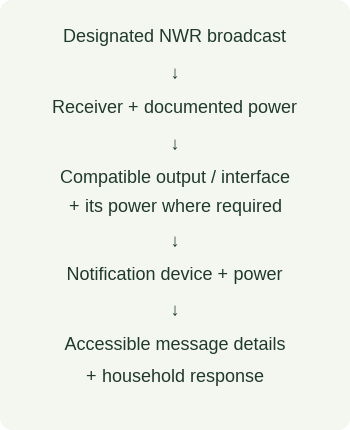
Identify the actual person’s daytime and sleeping notification needs. A visible light in another room, an unheard alarm or an accessory not connected as documented can leave an important gap. Use the manufacturer’s supported arrangement and qualified installation when required; do not improvise electrical connections.
Source: [1]
Confirm exact compatibility before buying
On a narrow screen, swipe inside the table. You can also focus it and use the arrow keys.
| Component | Question to resolve | Useful evidence |
|---|---|---|
| Receiver | Does this exact model provide the required supported output and area-selection function? | Model manual and complete designation. |
| Interface or connection | Is it documented for the receiver and notification device? | Both instructions or manufacturer compatibility confirmation. |
| Notification device | Does its intended signal address the person’s actual need and placement? | Device instructions and a planned usable location. |
| Power for each component | What powers it, and what is supported during an outage? | Separate power/backup instructions and maintenance. |
| Message details | How will the person obtain current area, hazard and action information? | Accessible official information method and household handoff. |
NWS says consumer receiver notification outputs are optional; not every radio has them. Its named products and vendor lists are examples, not endorsements, stock information or a universal compatibility table. A connector that fits physically does not resolve signal, interface or power compatibility.
Include every component in the power plan
NWS specifically warns that alarm devices may need external batteries or power supplies and says to make sure the alarm works during a power failure. Treat the radio, interface and notification device as separate power questions wherever the documentation does.
Record the actual supported backup and maintenance arrangement for each component. Do not assume that receiver batteries power a separate accessory, or that a module using the home’s electrical wiring continues operating in an outage. This guide provides no battery runtime or electrical design.
Check the supported complete arrangement during ordinary preparation using its actual instructions. Record what was observed, including the signal and component involved. An accessory’s local test, ordinary NWR audio and receipt of a transmitted test do not necessarily exercise the same chain. The weekly-test guide keeps those observations distinct.
Make the warning information accessible
The notification signal calls for attention; the household still needs the actual warning’s area, hazard, timing and protective action. NWS describes obtaining additional text information from weather.gov or other accessible emergency broadcasts when that can be done without putting the person at risk.
Agree in advance how the person will receive current instructions and how household members will communicate. Do not postpone an already applicable protective action while filling a record. The correct action comes from the current official warning and local procedures, not from this equipment diagram.
Keep another workable official information method. WEA is complementary, but device capabilities and presentation vary; an app or a silent phone is not proof of complete warning delivery. For exact phone settings or accessory behavior, obtain current support for that actual device.
Work through three incomplete-system examples
- Unverified output: a hypothetical radio description lists a warning light but no supported accessory output. A planned bed shaker remains unverified; obtain exact model and compatibility information before treating it as a system.
- Incomplete backup: the hypothetical radio has backup batteries, but the separate strobe’s instructions have not been checked. The complete outage notification arrangement remains unresolved.
- Attention without instructions: a hypothetical accessory activates, but the household has no accessible method for obtaining the current message. Plan that information step and household response; activation alone supplies no area or action.
These are invented documentation cases, not product tests or assessments of a person’s needs. Ask a supplier or manufacturer a concrete question using the complete model list, interface, power sources and required function.
Download the blank notification-chain check (TXT). Fill it with actual documentation and observations; no model, result or warning is prefilled.
Case 1
A jack and plug fit. Is supported compatibility proved?
Show answer and explanation for case 1
No. Obtain the documented receiver/interface/accessory relationship.
Physical fit does not establish the signal or power arrangement.
Case 2
The radio has batteries, but the separate alarm’s power is unknown. Is outage notification resolved?
Show answer and explanation for case 2
No. Keep the alarm power question open.
Every separately powered component needs its own supported arrangement.
Case 3
The strobe activates. Does that alone provide the warning’s instructions?
Show answer and explanation for case 3
No. The household still needs accessible current message information and action.
Calling for attention and communicating the area, hazard and action are different tasks.
Sources and further reading
- NWS: NWR for Deaf and Hard of HearingReceiver outputs, interfaces, notification devices, separate power and access to warning details; no product endorsement or compatibility certification.
- NWS: NWR Receiver Consumer InformationWeather-band and alert capabilities, model-specific instructions, logos, backup power and optional outputs; vendor listing is not an endorsement.
- NWS: NWR AlarmsBroadcast sequence and receiver-dependent alert activation; no model-specific test or accessory behavior is asserted.
- NWS: Wireless Emergency AlertsWEA and other information routes, device capabilities and instructions to follow the emergency message.