Practical guide
Refrigerator and Freezer Preparation Before a Storm
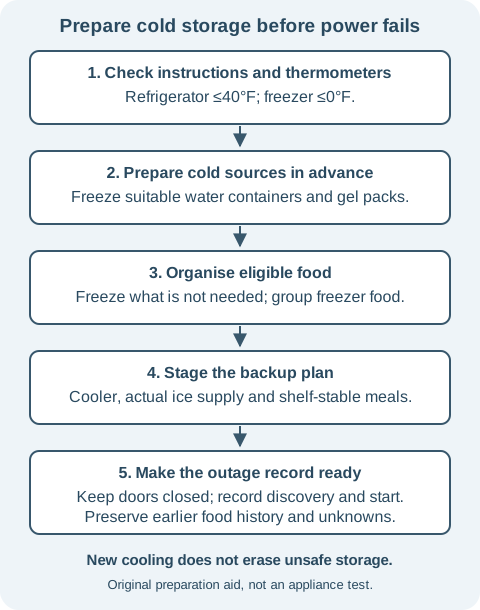
Prepare actual cold storage before power fails: verify thermometer readings, freeze suitable cold sources, organise eligible food and stage a realistic cooler and backup-meal plan. Includes two records, three tables and six cases.
Prepare while the household can still act safely
Before a storm, check appliance thermometers, freeze cold sources in advance and make a realistic backup plan. Keep the refrigerator at 40°F or below and the freezer at 0°F or below. Have a cooler, ice or frozen packs and shelf-stable meals ready before losing power makes preparation harder.
FDA's power-emergency guidance and CDC's emergency food guidance recommend these advance preparations. This article turns them into a household checklist, with editable records and examples. It addresses preparation before an outage; the linked guides below handle actual temperature records, cooler packing and freezer-food assessment afterward.
Read local alerts and any evacuation instructions first. Food preparation should not delay leaving, urgent help or another required safety action. No forecast, appliance, cold source or food has been inspected here. The guidance is from United States agencies; use applicable local public-health instructions for your situation.
A completed checklist is not a promise that food will remain safe for a fixed duration. It makes the actual equipment, supplies and missing decisions visible. If a task is unfinished, record it as unfinished rather than treating a shopping list or a freezer setting as completed preparation.
Check actual temperatures, not only the control setting
Keep an appliance thermometer in both the refrigerator and freezer. FDA's handling guidance recommends a refrigerator consistently at 40°F or below and a freezer at 0°F or below. These correspond approximately to 4°C and −18°C; preserve the thermometer's original displayed unit in your record.
A control dial marked “3” or “colder” is not a temperature measurement. Record the appliance, thermometer, displayed value, unit and measurement time. Follow the actual device and appliance instructions for appropriate placement, use, cleaning and any checking procedure. This guide supplies no universal calibration or sensor-placement method for every product.
| Check | What to confirm | Record | Do not assume |
|---|---|---|---|
| Refrigerator temperature | An appropriate appliance reading at 40°F or below. | Value, unit, thermometer and actual time. | A numbered control setting measures temperature. |
| Freezer temperature | An appropriate appliance reading at 0°F or below. | Value, unit, thermometer and actual time. | A frozen-looking package verifies every location. |
| Device use | The actual instructions and a readable, usable device. | Placement/method and error or missing information. | A food probe and appliance-air device answer the same question. |
| Cold sources | Water containers or gel packs actually frozen in advance. | Type, location and completed or pending status. | Buying packs means they are already frozen. |
| Cooler and supply | A usable cooler and cold sources actually available. | Location and replenishment limitation. | A cooler alone continues refrigeration. |
| Food and separation | Eligible foods, sound containers and raw-food separation. | Foods moved/frozen and unresolved history. | Freezing repairs food already stored unsafely. |
| Outage information | A place to record times and use current official updates. | Discovery, actual start if known and responsible person. | The time you notice an outage is its confirmed start. |
If a reading is warm, missing or doubtful before the storm, preserve that fact and address the actual problem through appropriate instructions or qualified help. Do not mark the appliance checked because a later reading is cold, or decide that every existing perishable is safe from one air measurement. Each food's earlier handling remains a separate question.
Freeze cold sources and eligible food in advance
FDA advises freezing water containers for ice, preparing ice cubes and gel packs ahead of time, freezing refrigerated foods you may not need immediately, and grouping food together in the freezer. CDC likewise recommends frozen water containers and gel packs. These are advance actions; they do not establish a fixed number of packs or freezing hours for your appliance.
| Task | Practical preparation | Limit |
|---|---|---|
| Freeze water containers | Use safe water and suitable containers according to their instructions. | A filled container is not yet a frozen cold source; allow for the container's freezing requirements. |
| Prepare gel packs or ice | Freeze them ahead of time and identify where they are stored. | A pack at room temperature is not ready merely because it is on the list. |
| Freeze food not needed immediately | Use eligible properly handled items and suitable packaging. | Do not freeze questionable perishables as a rescue. |
| Group freezer food | Keep the freezer food together as FDA recommends, within the appliance's actual instructions. | Do not transfer this advice into blocking refrigerator airflow or overloading an appliance. |
| Separate raw and ready-to-eat food | Use sound packaging and prevent raw-food leakage. | Cold temperature does not clear cross-contamination. |
| Protect supplies from contaminated water | Keep food and safe drinking water out of expected flood exposure where feasible. | An unopened package is not automatically waterproof or safe after flood contact. |
FDA's safe handling guidance says to refrigerate or freeze perishables promptly and never thaw food on the counter. Do not leave food out while rearranging the kitchen and then use a before-storm checklist to disregard its handling history. Keep raw meat, poultry, seafood and eggs separate from other foods.
Choose foods to freeze according to what you expect to use and the item's appropriate handling. Freezing can affect texture; it is not a requirement to freeze every carton or cooked dish. If you later assess partially thawed freezer food, use the separate category guide rather than a blanket “refreeze everything” rule.
Make the cooler and backup-food plan before you need it
Have a cooler and actual cold sources available while appliances are still working. FDA advises preparing coolers when a power loss could exceed four hours. CDC says that, after four hours without power, refrigerated perishables should be moved to an available cooler with ice or another cold source to keep them at 40°F or below. [FDA; CDC]
Prepare before that point; do not wait for a deadline to discover there is no ice, the packs never froze or the cooler cannot be found. Keep the earlier food history with any eventual transfer. A cold destination does not restart a safety allowance or repair earlier unsafe storage.
| Situation | Official planning guidance | Keep this limit |
|---|---|---|
| Unopened refrigerator during outage | About four hours of retained cooling, according to FDA. | Not four hours of permission on a counter or above a temperature threshold. |
| Full freezer with door closed | Approximately 48 hours, according to FDA. | A planning estimate, not a tested duration for your appliance or every package. |
| Half-full freezer with door closed | Approximately 24 hours, according to FDA. | Do not write 48 hours simply because it is a freezer. |
| Cooler with actual cold sources | CDC uses 40°F or below and directs checking cooler foods. | No universal ice ratio or guaranteed number of hours is established here. |
| Unknown or already unsafe history | Keep unknowns visible and follow applicable food guidance. | New ice, a restored freezer or cooking does not erase unsafe handling. |
Know where additional ordinary ice or cold packs can actually be obtained, with a fallback if that supply is unavailable. Do not make the plan depend on a shop remaining open or a journey being safe during the storm. Follow local warnings rather than travelling through a hazardous situation to save food.
FDA discusses dry or block ice as options, but this ordinary household checklist does not provide dry-ice handling, ventilation, generator installation or electrical instructions. Use the relevant actual safety and manufacturer guidance if a specialised option is considered.
Stage shelf-stable meals and safe drinking water so the household is not pressured to eat questionable perishables. Keep food and water contamination separate from cooling: a cold reading does not clear floodwater exposure.
Four fictional preparation problems
These invented examples show what the checklist should reveal. They are not measurements of real appliances, foods or ice supplies.
1. The dial is set but the temperature is not known
Nora writes “refrigerator checked” after turning the dial to a colder number. There is no actual thermometer reading.
Clearer record: Temperature not measured. Obtain or use an appropriate appliance thermometer according to its instructions; record the real value and unit.
A control setting does not establish normal storage or the earlier condition of the food.
2. The ice packs are bought but not frozen
Dev has a cooler and two new packs on a shelf. The storm checklist calls the cold supply ready.
Clearer record: Cooler available; packs still preparing. Freeze suitable cold sources ahead of time and keep their completed status separate from the purchase.
The example number of packs is not a recommended ratio or tested cooler capacity.
3. A half-full freezer is assigned a 48-hour guarantee
Rosa copies “48 hours” into the household plan without noting freezer fullness or door opening.
Clearer record: FDA's approximate half-full, closed-door estimate is 24 hours. Keep the stated condition and do not call it a guarantee for these foods.
Adding new food or opening the door does not create a fresh guaranteed period.
4. A warning changes the household priority
Wei is still sorting freezer packages when local officials issue an evacuation instruction.
Clearer action: Follow the local instruction and stop the food preparation. Keep the incomplete task incomplete rather than delaying departure to finish the form.
Advance preparation helps reduce later tasks; it is not a reason to stay through an urgent instruction.
Make the last check and assign the outage record
Before conditions change, make one practical review: thermometers usable, cold sources prepared, eligible food organised, cooler and backup meals located, and current information available. Record an unresolved task with the actual next step rather than repeatedly opening appliances to create a perfect-looking checklist.
Agree who notes when power is lost or discovered. Those can be different times. Make a paper or otherwise usable record available before an outage affects devices. A previous thermometer reading belongs at its measurement time; it cannot be copied across every unobserved hour.
Let other household members know which supplies are prepared and which are still pending. “The packs are in the freezer but not confirmed frozen” is more useful than “everything is sorted.” Include the appliance identity when there are several refrigerators, freezers or coolers.
If power fails, keep doors closed as much as possible and move to the actual outage plan. Assess foods with the relevant official guidance and their known histories. Do not taste food to decide whether it is safe, and do not use smell or appearance as clearance. Appropriate local help takes priority for an immediate concern.
Copy the preparation and outage-plan records
The first card records what is actually ready before the storm. The second makes the outage handoff explicit. Keep readings at their actual times, unfinished tasks unfinished and food-history questions visible.
BEFORE-STORM — APPLIANCES AND COLD SOURCES
Date / household plan / current official update source:
Refrigerator thermometer / displayed value and unit / time:
Freezer thermometer / displayed value and unit / time:
Device instructions checked / error or uncertainty:
Eligible foods frozen in advance / actual completion:
Water containers or gel packs / frozen or still preparing:
Cooler available / cold source / supply limitation:
Shelf-stable meals and safe drinking water available:
Who records outage discovery and actual start if known:
Unfinished task / person responsible / appropriate next step:
Local instructions and personal safety come before food tasks.
BEFORE-STORM — OUTAGE PLAN HANDOFF
Named refrigerator, freezer and cooler:
Current cold-storage readings and measurement times:
Food history or handling question already unresolved:
Keep doors closed; record actual outage start if known:
Discovery time, if different / start remains unknown:
Cooler/cold-source plan / actual supply and contact:
Transfer: food identity, time, earlier history and destination:
Public-health guidance and food-category record to use:
Floodwater or other contamination requires separate action:
Do not taste food, reset exposure or rescue unsafe food by cooking.
This plan is not a tested duration or a keep/discard calculator.
Download both editable records, three reference tables and six explained cases. The records do not inspect food or certify a storage duration.
Case 1
The refrigerator control dial reads “3,” but no temperature was measured. Is that a confirmed 40°F-or-below reading?
Show answer and explanation for case 1
No. Record the temperature as unmeasured until an appropriate actual reading exists.
A control setting is not a temperature unit. Identify the appliance thermometer, displayed value, unit and time, following the actual instructions.
Case 2
Gel packs have been purchased but are still at room temperature. Is the cold-source preparation complete?
Show answer and explanation for case 2
No. Keep the purchase and the freezing action separate.
The sources recommend freezing packs in advance. An item on a shopping list is not a completed frozen cold source or a tested amount of ice.
Case 3
A half-full freezer is kept closed. Does the FDA planning estimate give it the same 48 hours as a full freezer?
Show answer and explanation for case 3
No. FDA gives approximately 24 hours for a half-full closed freezer.
Both durations have conditions and are planning estimates. They are not guarantees that every package stayed suitable or that opening the door is irrelevant.
Case 4
Questionable perishables were already stored unsafely before the storm. Can freezing them now reset their history?
Show answer and explanation for case 4
No. Follow the appropriate food guidance; freezing is not a rescue for unsafe storage.
New cooling and subsequent cooking cannot erase an unsafe history. Keep uncertainty visible and do not taste-test questionable food.
Case 5
You have a cooler but no usable ice or cold packs. Does the cooler by itself continue refrigerator storage?
Show answer and explanation for case 5
No. A cooler needs actual cold sources and suitable conditions.
CDC uses 40°F or below for cold storage and directs checking cooler foods. No universal packing ratio or guaranteed duration is supplied by this checklist.
Case 6
An evacuation instruction arrives while the preparation record is unfinished. Must every field be completed before leaving?
Show answer and explanation for case 6
No. Follow the local instruction and stop the food task.
The record is an advance planning aid. It must not delay evacuation, urgent support or another required safety action.
Use the right guide if power fails
Keep preparation, storage history and food assessment as separate tasks. The first-four-hours refrigerator checklist covers the immediate outage. The temperature log records readings and missing intervals. The cooler guide handles ordinary ice packing and replenishment. The freezer guide explains category-specific refreezing decisions.
CDC says never to taste food to decide whether it is safe and to discard it when in doubt. FDA warns that inadequately refrigerated or frozen perishables can cause illness even when thoroughly cooked. Do not choose a more permissive isolated statement to clear an unknown or unsafe history.
Floodwater or stormwater exposure requires its own official contamination guidance. This checklist supplies no package-salvage, disinfection or appliance-repair procedure. If a medical condition, medicine or medical device depends on refrigeration, use appropriate professional and manufacturer instructions; ordinary food targets cannot decide those requirements.
After the event, record one concrete preparation gap: a missing thermometer, packs not frozen, an unavailable cooler or an unreliable information source. Fix that gap before the next storm rather than assuming a successful checklist guarantees the next outage.
Sources and further reading
- FDA: Food and Water Safety During Power Outages and FloodsFull document: advance thermometers, frozen water/ice/packs, eligible food freezing, grouping freezer food, cooler planning and closed-appliance estimates; unsafe handling not rescued by cooking. Separate restoration wording not converted into a warmer cooler target.
- FDA: Safe Food HandlingFull document: normal appliance targets, raw-food separation, prompt refrigeration and no counter thawing. No universal device placement, calibration or tested thermal duration.
- CDC: Keep Food Safe After a Disaster or EmergencyComplete current visible #content read in normal browser, HTTP status not observed. Advance thermometers/cold sources/cooler, 40°F-or-below cold storage, four-hour transfer conditions, never taste and contamination boundary. No destination, food or appliance tested.