Household preparedness · Updated 2026-11-03
School Pickup Plan: Family Handoffs and Backup Contacts
Build one clear school pickup plan instead of relying on scattered messages. The worksheet separates ordinary dismissal, backup availability, school confirmation and emergency instructions.
Before the first pickup: obtain the school’s actual release and change procedures, name the adult responsible on each day, and verify the backup arrangements through the school’s required process. A family group message does not by itself change school authorization.
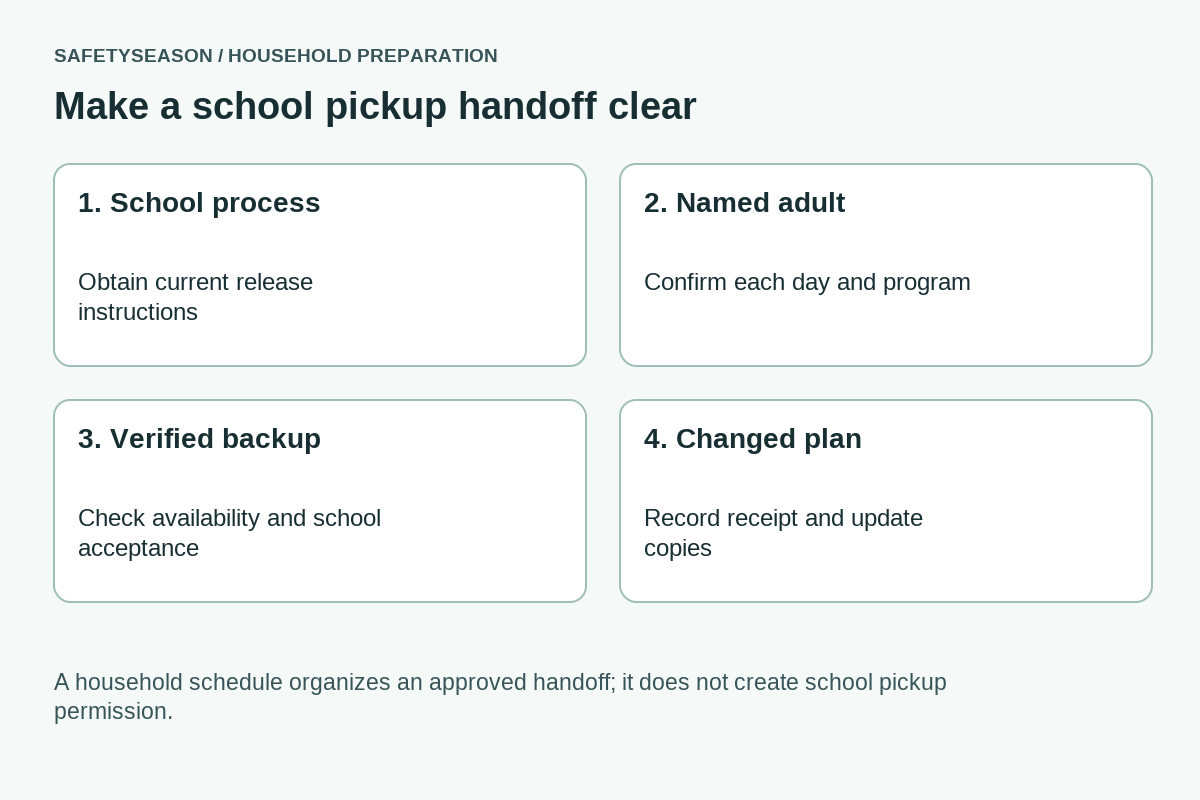
Start with the school’s instructions, not an assumed routine
Ask where the school publishes its current arrival, dismissal, late-pickup and emergency-reunification procedures. Save the official contact route and identify how the school accepts an authorized pickup change. The procedure can differ between a school day, an after-school program and an emergency. Keep those distinctions in the record.
Record what the responsible adult needs to bring or confirm under that procedure, without inventing an identification requirement or release rule. Check how after-school providers handle the handoff if the child moves between services. A familiar adult, a family password or an old pickup message is not a substitute for the school’s actual requirements.
If custody, permission or safeguarding arrangements affect collection, use the school and appropriate authorized professionals to establish them. This article cannot decide who may collect a child or reinterpret a legal document. The planning task is to make the approved arrangement findable and keep its operational details current.
| Day or situation | Confirmed arrangement | Backup or unresolved action |
|---|---|---|
| Regular dismissal | Responsible adult, program, official collection point and relevant procedure | Named backup accepted through the required school process. |
| After-school program | Who receives the child and who handles final collection | Provider contact and change procedure recorded separately. |
| Delay or adult unavailable | Who contacts the school and by which official method | Follow the school’s late-pickup instructions; do not invent an informal release. |
| School closes or emergency changes collection | Official information source and school reunification instructions | Follow the current instructions; the ordinary meeting point may no longer apply. |
| Contact details change | School record and relevant caregiver copies updated | Receipt or acceptance checked; old contact copy replaced. |
Name one responsible adult for the actual day
Write the adult responsible for collection beside the day and program. Avoid “one of us will go” if nobody has accepted the task. The adult should know the collection point, timing, required school procedure and how to contact the school if delayed. Review transport and the child’s established accessibility or support needs through the appropriate existing arrangements.
Keep the schedule readable when work shifts, clubs or another caregiver change the week. A recurring calendar entry helps only if the adult can access it and has agreed to the task. Check a changed day with the person, rather than assuming that sending an invitation completes the handoff.
Distinguish a proposed backup from a verified backup. The person needs to be available, understand the task and meet the school’s authorization process. A name written on a household sheet proves none of those things on its own. Record any outstanding step and who will resolve it before relying on that person.
Use a change log instead of an expanding message thread
When collection changes, record the date, affected child/program, proposed adult, school contact method and whether the school accepted the change under its rules. Keep the details in the private family record. Do not treat a message’s “sent” status as confirmation of school receipt or authorization.
Notify the relevant responsible adults with only the information needed for that handoff. Confirm which version they are using, and remove or clearly supersede the outdated arrangement in your own records. Avoid having three people rely on three screenshots of different plans.
If the change cannot be confirmed, contact the school through its official route and follow its instructions. Do not send a child to an improvised meeting point or tell an adult to bypass a release check because the household is running late. Uncertainty belongs in the record as an unresolved task.
Give the child a simple, consistent explanation
Explain the ordinary arrangement in a way the child can understand, using the school’s existing instructions. The child should know which responsible adult or school staff member to approach if the routine changes. Ask the school how it teaches dismissal and reunification, so household explanations reinforce that process.
Practice an ordinary explanation when everyone is calm. For example, ask the child to describe where the school says to wait and whom to ask for help. This is a conversation about the approved routine, not a test that transfers responsibility for release decisions to the child.
Do not publish names, photos, daily collection times, routes, access details or medical information in a public worksheet. Share necessary information privately with the school and relevant caregivers through appropriate established channels. This site’s blank download does not collect those answers.
Prepare for a phone or schedule failure
Ready.gov recommends a household communication plan, a familiar meeting place where appropriate, planning for school-aged children and practicing the plan. Apply that general guidance by keeping the school’s number and the relevant contact details available if a phone battery or account fails. Use the school’s actual emergency arrangements for release and reunification.
Agree who follows up when the responsible adult cannot be reached. Record the appropriate school contact and how the backup will be contacted and confirmed. A family meeting-place suggestion does not override a school closure, evacuation or reunification instruction.
Check the plan after a changed phone number, new term, program change, caregiver change or updated school policy. Keep a dated version and a short list of unresolved items. A review that finds an unverified backup is useful progress; mark that gap honestly rather than calling the plan complete.
Four situations to work through
Two adults each assume the other is collecting
Assign one named adult for the actual day and obtain their confirmation. Update the private schedule and the relevant accepted school arrangement. A shared calendar without an accepted owner can reproduce the same gap next week.
A grandparent is free but not yet confirmed by the school
Use the school’s authorization process before relying on the grandparent as a backup. Record the step still outstanding, the school contact and who will resolve it. Familiarity to the family is not evidence of authorization.
A pickup-change message has no reply
Contact the school by its official method and follow its instructions. Retain the distinction between a proposed change and a confirmed arrangement. Do not ask the child to leave the approved waiting place on the strength of an unconfirmed family message.
An emergency notice names a different reunification location
Follow the school’s current official instructions, including any access or release process. The regular dismissal row remains a record of the ordinary day; it does not establish what to do during the changed situation.
Questions that change the next step
Is this a permission or custody document?
No. It is a household handoff record. The school’s required authorization process and applicable arrangements determine release; this article does not establish permission.
How much information should the backup adult receive?
Provide the information needed for the approved handoff and relevant established support arrangements, through appropriate private channels. Avoid distributing a full family or medical record when a smaller set of information will serve the task.
Use a separate guide for the next task
- Household document retrieval — keep private records findable
- Heatwave cooling and check-ins — prepare a changed day around current conditions
Keep a usable household record
Download the blank school pickup handoff record (plain text). Keep children’s details and daily routines private. Confirm the school’s procedure before treating a household change as an authorized pickup.
Sources and scope
Ready.gov supports household communication planning, considering school-aged children and practicing a plan. The pickup record is an editorial application of those principles. School policies, authorized release arrangements and current emergency instructions govern collection.