Practice worksheet
A Household Backup Lighting Plan for Power Outages
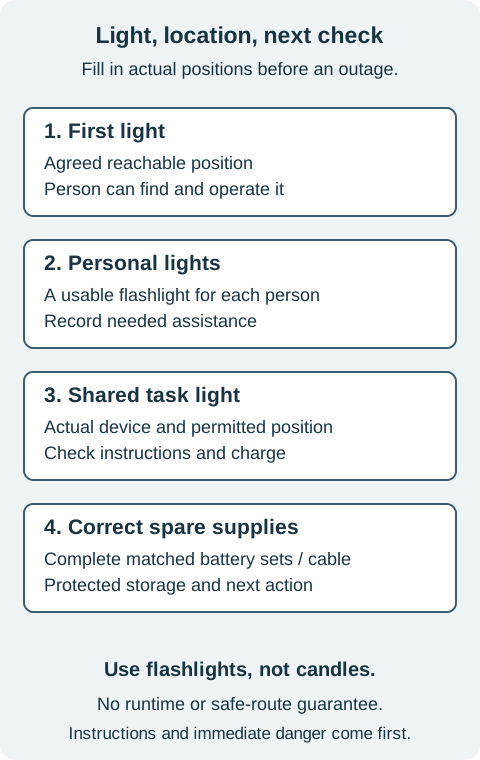
Make the first light findable, assign usable personal lighting and record complete battery sets, charging readiness and actual positions. Keep the missing item visible before relying on the plan.
Make the first light findable before buying more
Prepare outage lighting by giving each household member a usable flashlight, identifying a first light that can be reached without a room-to-room search, and recording the batteries or charging setup for the actual devices. Put the locations and unresolved supplies on paper. Use flashlights rather than candles during a power outage, as the U.S. Fire Administration advises.[3]
Start with the moment ordinary room lights fail. Where is the light you can reach from your usual evening or sleeping position? Who needs help operating it? A cupboard full of equipment does not answer those questions if only one person knows where the key is.
Ready.gov recommends a flashlight for every household member and an inventory of items that rely on electricity.[1] That is a U.S. preparedness recommendation, not a universal lumen requirement or a finding about your home. Adapt the arrangement to actual people and the devices they can operate. Keep children from accessing loose batteries or electrical equipment.
The family power outage checklist covers the immediate household jobs, alerts, food and separate medical needs. This article completes the narrower lighting preparation: positions, device instructions, complete battery sets, charge readiness and an alternative for each important task. If smoke, fire, flooding, an alarm or immediate danger is present, get to safety and follow local emergency instructions before searching for a torch.
Separate a personal flashlight from shared room light
A portable flashlight helps a person see while moving or looking for an item. A battery-powered area light may help people gathered in one place. A headlamp can leave hands available if the person can use it comfortably. Those are possible roles, not a requirement to buy three products per person.
| Role | Possible device | Check before relying on it | Keep separate |
|---|---|---|---|
| First light | A familiar flashlight in an agreed reachable position. | Can the intended person find and operate it without fetching supplies elsewhere? | The first light is not all household lighting. |
| Personal light | A flashlight assigned to an individual. | Battery instructions, grip, switch and assistance needed. | An area light does not automatically replace personal lights. |
| Shared task light | An appropriate battery area light or supported hands-free light. | Permitted placement, stable position and the actual task. | Do not cover, suspend or modify equipment against its instructions. |
| Alternative supply | Another suitable flashlight or instructed complete spare set. | Device is available and the correct batteries or charge are ready. | A second empty rechargeable lamp is not an independent ready supply. |
Choose by the task rather than brightness alone. A light that is uncomfortable to hold, confusing to switch on or difficult to locate is a planning problem even when its advertised output is high. Ask the intended user which setup works for them; do not infer that a headlamp or a small switch meets everyone's needs.
Check the manual for allowed positions, temperature, moisture and charging conditions. Do not treat a household lantern as a waterproof outdoor light because it resembles camping equipment. Keep walkways and exits unobstructed, and arrange equipment while conditions are normal. This worksheet does not inspect your route, qualify a mounting point or replace a household fire escape plan.
Record complete battery sets and keep types distinct
Read each device's battery compartment and instructions. Record the specified size, type and quantity, including how the positive and negative ends are oriented. A drawer marked “spare batteries” is incomplete when the lamp needs three of one type and the drawer holds two plus an unrelated cell.
Energizer's battery-care guidance says to use the size and type specified by the device, insert batteries according to the polarity symbols, replace all batteries together with new batteries of the same size and type, and avoid mixing old and new batteries or different types or makes.[4] Follow the actual device and battery instructions; a familiar physical shape does not establish compatibility.
For a fictional flashlight requiring three AA cells of the specified type, one complete replacement set means three appropriate cells together. Label the set for the intended device. Do not complete it by borrowing a partly used cell from another item. This is an inventory example, not advice that every AA chemistry is interchangeable.
Keep batteries protected from contact with coins, keys or other metal. Energizer cautions against carrying loose batteries with metal objects and recommends cool, dry storage at normal room temperature; refrigeration is unnecessary.[4] Choose a storage arrangement that also keeps batteries, especially small and coin cells, away from children. Do not place loose batteries beside a child's bedside flashlight merely to make them convenient.
Remove exhausted batteries and follow the device instructions for extended storage. Do not disassemble, puncture, crush or burn batteries, and do not try to recharge a battery unless it is marked rechargeable. Disposal rules depend on the battery and local arrangements; identify the type and follow applicable instructions rather than using one disposal rule for every cell.
Check rechargeable lights without promising runtime
For a rechargeable light, identify the exact compatible charger, input and cable. Keep the manual's charging method with the device name in your record. A USB plug fitting does not, by itself, establish that an adapter, port or charging arrangement is permitted.
Rechargeable batteries can lose charge while stored. Energizer advises following the manufacturer's storage and care instructions and using chargers designed for the battery type.[4] Its page includes particular charging and maintenance suggestions, but they should not be imposed on every integrated lamp or battery chemistry. Use the exact lamp and battery guidance for your review schedule.
In normal conditions, use the intended setup according to its instructions and observe whether the light operates and the charging indicator behaves as described. Record the date, device and mode. A brief successful switch-on is useful evidence that the setup operates now; it does not measure remaining usable energy or prove it will last through an unknown outage. Do not deliberately exhaust a device to complete this checklist.
If the manufacturer supplies runtime figures, retain the stated mode and test conditions. “Up to” runtime in a low-output mode is not a promise for a brighter setting, an aged battery or a partially charged start. No universal lumen target, lamp-hours formula or number of outage days is provided here. If a plan depends on a runtime you cannot establish, add an appropriate ready alternative or resolve the question with the manufacturer.
Keep phone power on its own record. The phone power-bank estimator separates stored energy, USB output and phone top-ups; it does not calculate lamp or medical-device suitability. Do not assume that a phone bank can run a light while charging itself unless the relevant manufacturers permit that exact arrangement.
Write the actual positions and the remaining gap
Create a small position register while the house is normally lit. Use recognisable descriptions such as “bedside drawer, front compartment” rather than “somewhere upstairs.” Agree positions with the people who use them. If access depends on a key, shelf height or another person's help, record that dependency and resolve it before relying on the station.
| Task or person | Fictional position and supply | Remaining preparation |
|---|---|---|
| First light | Usual evening position: assigned flashlight, switch understood. | Confirm an agreed reachable location with the intended user. |
| Shared table task | Battery area light stored with its permitted stand. | Check the manual, placement and complete required battery set. |
| Person needing help | Personal flashlight at their agreed position. | Name the available helper and an alternative if that person is absent. |
| Rechargeable light | Device and compatible cable in labelled storage. | Read charging instructions and record current observation; runtime remains unknown. |
| Spare supply | Protected complete sets labelled for specific devices. | Confirm battery type, quantity and child-safe storage arrangement. |
These entries are original examples, not a plan of your building. Replace every fictional position with an actual one. The diagram below shows the register's relationships; it does not mark a safe evacuation route or tell you where to mount lights.
Store a paper copy with the agreed supplies and make sure relevant household members know where it is. Ready.gov recommends a designated kit place known to family members, and reconsidering needs as the household changes.[2] Avoid a record available only on a phone whose battery or network may fail.
Put a person and next action beside each missing item: “Jordan will locate the compatible cable,” “replace the complete specified set,” or “ask the manufacturer about the permitted adapter.” An empty box that says “all set” is less useful than an honest unresolved question. Preparation is complete for this task only when the identified lighting dependencies have workable arrangements.
Keep flames out of the outage lighting plan
The U.S. Fire Administration explicitly advises using flashlights, not candles, during a power outage.[3] Its candle page also explains that open flames can ignite nearby material or become dangerous if knocked over. Do not use a bottle, a stable-looking table or a person watching the flame as a reason to make candles the backup lighting plan.
A battery-operated decorative candle avoids an open flame, but it may not provide the visibility needed for moving or a particular task. Check its actual usefulness and instructions rather than treating “flameless” as proof it replaces a flashlight.
A shortage of charged lamps is a supplies problem to address before an outage, not a reason to bring fuel-burning equipment indoors. Keep generator, cooking, heating and electrical repair decisions with their specific safety instructions and qualified help. Ready.gov describes serious carbon-monoxide and electrical hazards.[1] This article does not approve any generator placement, wiring or fuel arrangement.
Lighting cannot make a hazardous home safe to remain in. Follow official instructions and act on immediate danger, medical needs or unsafe heat and cold. Do not delay leaving or seeking help to finish a checklist, fetch a spare lamp or restore a charging setup.
Seven checks before calling the lighting plan ready
These original fictional checks test the preparation record. They are not reports of tested devices, household inspections or emergency outcomes.
Check 1: The shared lantern works. Does that complete personal lighting?
Show answer and explanation for lighting check 1
No. Ready.gov recommends a flashlight for every household member. Identify each person’s usable light and assistance, as well as the shared task light.
Check 2: A light needs three specified AA cells; two new cells and one partly used cell are available. Is the spare set ready?
Show answer and explanation for lighting check 2
No. Arrange a complete instructed set. Energizer advises replacing batteries together and not mixing old and new cells; matching shape alone does not establish battery-type compatibility.
Check 3: The lamp switched on for a few seconds. Can the record promise eight hours?
Show answer and explanation for lighting check 3
No. Record the successful observation and mode. It does not measure remaining energy; any manufacturer runtime needs its specific conditions.
Check 4: Two rechargeable lamps are stored flat, with one missing cable. Is the second lamp a ready alternative?
Show answer and explanation for lighting check 4
No. Resolve charge readiness and the compatible connection. Two unavailable devices do not provide a usable alternative.
Check 5: A child can reach the flashlight and the loose spare cells beside it. Is the storage question finished?
Show answer and explanation for lighting check 5
No. Keep loose batteries and especially small or coin cells away from children. Arrange usable personal lighting and appropriate adult-controlled spare storage separately.
Check 6: Candles are in sturdy holders, but flashlights are missing. Should candles be the outage light plan?
Show answer and explanation for lighting check 6
No. USFA advises flashlights rather than candles during a power outage. Resolve the flashlight shortage; a stable holder does not remove the open flame.
Check 7: Smoke or an alarm appears while someone is looking for the backup light. What takes priority?
Show answer and explanation for lighting check 7
Getting to safety and local emergency instructions. Do not remain in immediate danger to complete the register, recover supplies or charge a device. A lighting plan cannot clear a hazardous setting.
Copy the lighting record and restore supplies after use
HOUSEHOLD OUTAGE LIGHTING — EDIT YOUR OWN COPY
Household / date / person maintaining this record:
People needing a personal light or assistance:
First-light position, reachable without searching another room:
Exact device, battery compartment instructions and manual location:
Battery size / type / quantity per complete replacement set:
Spare-set location / protected storage / child access considered:
Rechargeable device / compatible charger and cable / charge indicator:
Task or room / actual station / device assigned / person responsible:
Assistance needed to operate, hold or carry the light:
Normal-setting switch and connection observation / date:
Manufacturer runtime mode and conditions, if supplied:
Remaining energy or runtime not established by that observation:
Alternative if the assigned device is unavailable:
Missing item / person arranging it / next check:
After use: restore device, complete battery set or charge as instructed:
Review trigger: use, device change, household change, manufacturer instruction:
This is a supplies record, not an evacuation map or electrical assessment.
Open the lighting register and seven explained checks (TXT). Copy it to your own paper or file. This page does not save entries, inspect the home or send reminders.
After ordinary use or an outage, return devices to their agreed positions and replenish complete battery sets or recharge as their instructions require. Review when a device, battery type, person, access arrangement or manufacturer instruction changes. A dated observation is more useful than a permanent “ready” label.
A fictional final note might read: “First flashlight operates in its normal setting; correct spare set is protected in the agreed adult-access storage; rechargeable area light's cable still needs locating; Alex will resolve that before relying on it.” The unfinished cable remains visible. The record does not claim a guaranteed night of light, a successful evacuation or tested runtime.
Sources and further reading
- Ready.gov: Power OutagesFull text: electrical inventory, flashlight for every household member and separate medical, generator and immediate-hazard planning. Food thresholds not used here.
- Ready.gov: Build A KitFull text: flashlight, extra batteries, kit location known to household and maintenance when needs change. No universal light quantity beyond the separate per-person source.
- U.S. Fire Administration: Candle Fire SafetyFull text: flashlights rather than candles during outages, open-flame hazards and flameless alternatives. Fire statistics not used.
- Energizer: Battery Do’s and Don’tsFull manufacturer text: instructed size/type/polarity, complete replacement sets, no mixed cells, protected storage, rechargeable-compatible chargers and local disposal. Its specific recharge temperatures/intervals and travel or ingestion instructions not generalised to every lamp.