Practical guide
Power Bank Capacity for Outages: Watt-Hours and Phone-Charging Estimates
Read the energy basis on your power bank, estimate a phone top-up budget with visible assumptions, and identify the cable, safety or planning gap that needs fixing before an outage.
Start with the communication task
List the phones that must receive warnings, contact family or show essential travel information. Identify who carries each phone and its cable. A household with three partly charged phones has a different problem from one person keeping a single phone ready. Include a paper contact card and an alternative source of local information; extra battery energy cannot restore a damaged mobile network.
U.S. Ready.gov includes a phone, chargers and a backup battery in its emergency-kit list, and advises taking an inventory of items that rely on electricity.[1][2] Neither page sets a universal power-bank size or promises a number of days. Decide which phone tasks matter, then check whether your actual bank can support them.
Keep powered medical devices and refrigerated medicines on a separate plan made with the medical provider and equipment or medicine guidance.[1] A phone calculator cannot establish that a medical-device backup is sufficient.
Read three different numbers on the label
| Label | Meaning | What to check |
|---|---|---|
| mAh | Electrical charge capacity, not an energy figure by itself. | The nominal voltage associated with that capacity. |
| Wh | Energy: watt-hours. | Stored-cell energy or energy available at a defined output? |
| W | Power: the rate at which energy can be transferred. | Input or output, one port or shared ports, and the required protocol. |
| Rated output capacity | A figure defined at an output voltage and specified test conditions. | Use those conditions; do not apply a cell conversion loss a second time. |
The unit relationship is Wh = mAh × nominal volts ÷ 1,000. For a fictional label pairing 10,000 mAh with 3.7 V, the stored energy is 37 Wh. Multiplying the same cell capacity by a USB port's 5 V would give 50 Wh and misidentify the basis. Use the voltage that belongs to the stated capacity, not whichever voltage looks convenient.
If the manufacturer already supplies Wh, use that stated value. The Anker A1695 product page describes 25,000 mAh as 90 Wh under its stated test conditions.[3] It is an example of why 3.7 V should not be imposed on every product. This guide does not recommend that model or transfer its performance to another bank.
Keep bank conversion and phone charging separate
Stored-cell energy passes through the bank's conversion electronics before reaching a USB-connected phone. Charging the phone also consumes energy; not all energy at the USB connection is stored in its battery. The phone may be using power at the same time. A comparison between stored bank Wh and phone battery Wh therefore needs clearly stated assumptions.
For A1695, the manufacturer describes approximately 63–70 Wh of usable output from the stated 90 Wh, depending on device, cable and charging protocol, and labels its data as internal testing.[3] Its FAQ uses a different mAh-based estimate. We use this page to explain the distinction, not to claim an independently measured efficiency or a universal loss percentage.
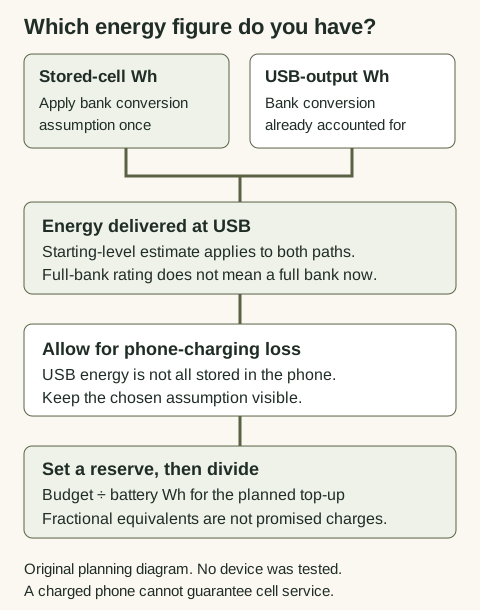
If you start with a manufacturer's USB-output energy estimate, skip the bank-conversion factor. You may still need a separate allowance for phone charging and use. If a manufacturer's quoted number already represents energy stored in a particular phone, neither of these generic stages should be reapplied without understanding that test. Use the specified test result directly within its scope instead.
Estimate phone top-ups with visible assumptions
The stored-cell path is bank Wh × starting fraction × bank conversion fraction × phone charging fraction × (1 − reserve fraction). Divide that energy budget by phone battery Wh × planned top-up fraction. The USB-output path skips the bank conversion fraction. Each percentage is a decimal in the calculation.
Defaults use a fictional 37 Wh bank, full starting level, 70% bank conversion, 85% phone charging, a 20% reserve and a fictional 15 Wh phone battery. These chosen assumptions produce 17.61 Wh after reserve and approximately 1.17 full-battery equivalents. The same budget divided by a 50% top-up portion of 7.5 Wh gives approximately 2.35 portions. This does not promise two successful charging sessions.
A top-up from 20% to 70% is 50 percentage points. It is not a 70% top-up. Phone indicators and charging behavior do not follow a perfectly repeatable energy measurement, so use this as a planning approximation. For different phones, calculate each planned energy portion and add the portions instead of pretending every battery has the same Wh.
Try less favorable assumptions and write down what changes. An older bank, temperature, charging protocol, cable condition, phone activity and battery behavior can change the result. If the plan only works at an optimistic value, arrange another suitable supply or a different communication plan before the outage.
Check power and compatibility before counting energy
A large Wh total does not ensure that the bank, port and cable can charge your phone as expected. Check the actual manufacturer's connection instructions, supported charging protocol and shared-port limits. A label saying 100 W does not mean the bank contains 100 Wh, or that every connected phone receives 100 W.
On the A1695 page, individual USB-C output and total multi-port output have different limits, and the manufacturer's peak input and pass-through statements have conditions.[3] Those are model-specific descriptions. Do not assume another bank accepts power and charges phones simultaneously, or that its peak advertised input gives a guaranteed recharge time.
Before an emergency, connect the actual intended phone and cable according to their instructions and confirm that charging starts. Record the setup and any unresolved problem. That basic compatibility check does not measure the bank's full usable energy or certify it safe. Avoid running a device flat merely to create a test figure for this guide.
Check the bank, instructions and recall status
Read the exact manual for your model and region. The A1695 safety sheet's English instructions specify an operating range of 0–35°C, no exposure to rain or snow, no use of damaged or modified banks, and no opening, crushing or incinerating.[4] These are instructions for that model, not a temperature specification for every bank. Its warning about excessive heat is not permission to operate above its listed operating range.
Check the manufacturer's current recall information and the applicable product-safety authority using the exact model and identifying details. A bank that still charges can be subject to a recall. The U.S. A1263 recall page instructs owners of confirmed affected units to stop using them and follow its replacement and disposal process.[5] It also says recalled lithium-ion batteries need special disposal arrangements; ordinary rubbish or curbside recycling is not the route.
That recall is a specific example, not a complete current list for every brand or country. If identifying information is missing, ask the manufacturer. If a bank is damaged, wet, unusually behaving or affected by a recall, stop using it and follow the relevant safety instructions. If smoke, fire or immediate danger is present, prioritize getting away and local emergency assistance over checking the label. Do not modify batteries, improvise repairs or use a capacity estimate to override a safety warning.
Keep a household phone-power record
Write the exact bank energy basis, the phone's battery specification, assumptions, intended cable and priority user in one place. Keep a copied manual or accessible official link with the model name. Add paper contacts and the local outage-information source. Recheck the bank's condition and readiness according to the manufacturer, and update the kit when household needs change.[2]
Record actual observations separately from estimates. “Indicator shows 75%” describes what you saw; “75% of rated Wh remains” is an assumption. “Charging icon appeared” describes a connection check; “three full charges available” is an unverified prediction unless supported by an applicable test.
Download the editable phone-power planning record
PHONE POWER PLAN — EDIT YOUR OWN COPY
Date / household / planned review date:
Bank make, exact model, region and manual URL:
Recall check date and result / unresolved question:
Full-bank energy (Wh) and where its label/specification states it:
Energy basis: stored cells / USB output (circle one):
If converting mAh: stated capacity and matching nominal voltage:
Actual starting indicator reading and its uncertainty:
Bank-conversion assumption (stored basis only):
Phone-charging assumption / reserve assumption:
Phone battery Wh, official source and planned percentage top-up:
Computed estimate and assumptions — not a guaranteed charge count:
Cable / port / actual compatibility check and date:
Bank condition, manual temperature and moisture limits checked:
Priority phone, paper contacts, alert source and non-phone backup:
Medical-device plan: separate provider/manufacturer arrangement:
Missing item / person arranging it / next check:
For the first household actions during an outage, use the family power outage checklist. It covers light, contacts, medical dependencies and when to seek help. Keep food-storage decisions on their own temperature and history record rather than treating a phone bank as refrigeration backup.
Practice the energy basis before using a result
These six cases are fictional arithmetic and reading exercises. They do not report tested products.
Case 1
A fictional label pairs 10,000 mAh with 3.7 V. A USB socket lists 5 V. Which voltage belongs in the stored-energy conversion?
Show answer and explanation for case 1
Use 3.7 V: the stated stored energy is 37 Wh.
The 5 V socket rating describes output voltage. It does not change the voltage associated with the stated cell capacity.
Case 2
A specification gives 26 Wh available at USB output. Should you apply a 70% bank-conversion factor before the phone-charging allowance?
Show answer and explanation for case 2
No. Choose the USB-output basis and skip bank conversion.
That stage is already reflected in the output-energy figure. Check the specification conditions and retain a separate phone-charging assumption if needed.
Case 3
Using the default fictional assumptions, change the planned top-up from 100% to 50%. What changes?
Show answer and explanation for case 3
The planned portion drops from 15 Wh to 7.5 Wh; the estimate changes from about 1.17 to 2.35 equivalents.
The energy budget is unchanged at 17.612 Wh. More fractional portions does not guarantee a number of sessions or mobile-network access.
Case 4
A bank advertises 100 W output. Does that mean it stores 100 Wh?
Show answer and explanation for case 4
No. Watts describe power; watt-hours describe energy.
Read the energy specification separately. Port, cable and protocol constraints also matter to the actual charging setup.
Case 5
Your bank shows 50% at the start. Can you use the full-bank estimate unchanged?
Show answer and explanation for case 5
No. Include the approximate starting level and its uncertainty.
The simple model scales energy by the starting fraction. A battery indicator is not a calibrated measurement of remaining energy.
Case 6
A confirmed recalled bank still charges normally, and your calculation looks sufficient. Can it remain in the outage kit?
Show answer and explanation for case 6
Stop using it and follow the applicable recall instructions.
Arithmetic does not override a recall or damaged-battery warning. Arrange an appropriate alternative and follow the specific disposal process.
Finish with the missing item, not a promised charge count
A useful result names the remaining problem: no compatible cable, unknown Wh basis, nearly empty bank, unverified recall status, an optimistic efficiency assumption or no alternative to cellular information. Assign who will resolve it and when the plan will be checked again.
Choose a bank by the communication tasks and actual specifications, then prepare a wider outage plan. Neither a capacity label nor this calculator guarantees how long the outage will last, that every charge will complete, or that it is safe to stay home when heat, cold, medical needs or official instructions require another action.
Sources and further reading
- Ready.gov: Power OutagesFull current text: electrical-dependency inventory, portable chargers, separate medical planning and outage safety. Its food wording is not used to set food-storage thresholds here.
- Ready.gov: Build A KitFull current text: phone, chargers, backup battery, paper/map/radio alternatives, household needs and kit maintenance; no universal bank capacity.
- Anker A1695: specifications and manufacturer estimatesFull current product text. Model-specific 90 Wh cell figure, 63–70 Wh output description, separate port/input conditions and inconsistent mAh FAQ estimates; manufacturer testing, not this site’s measurements or a product recommendation.
- Anker A1695 Safety Sheet: English instructions (PDF)Cover and English safety instructions on PDF pages 1–2 read with rendered page verification. Model-specific temperature, moisture, damage, modification and handling limits. Other language pages not fact-checked.
- Anker A1263 U.S. recall instructionsFull current notice: exact affected-unit checks, stop-use instruction and special recalled-battery disposal. An example, not a complete recall list or a check of your unit.